Mars is the fourth planet from the Sun and Earth’s outer neighbor.
Diameter: about half of Earth
Day length: 24.6 hours (a “sol”)
Year length: 687 Earth days
Because of its rusty color, caused by iron oxide (rust) in the soil, it’s called the Red Planet.
Key idea: Mars is similar enough to Earth to fascinate scientists, but different enough to be challenging.
Filters: f635, f546, f437 CU/LASP EMM/EXI ITF/Kevin M. Gill
Kevin Gill from Los Angeles, CA, United States
Basic Facts and Numbers
Gravity: ~38% of Earth’s. You’d jump almost 3× higher 🦘
Moons: 2 tiny moons, Phobos and Deimos
Average temperature: about -63°C (very cold!)
Atmosphere: thin, mostly carbon dioxide
> Mars is cold, dry, and has low air pressure, which makes it dangerous for unprotected humans.
Deimos, Moon of Mars ESP_012068_9000 - 2nd Observation (21 February 2009) http://hirise.lpl.arizona.edu/deimos.php HiRISE captured these enhanced-color images of Deimos, the smaller of the two moons of Mars, on 21 February 2009. Deimos has a smooth surface due to a blanket of fragmental rock or regolith, except for the most recent impact craters. It is a dark, reddish object, very similar to Phobos, shown here in enhanced HiRISE colors (near-infrared, red, and blue-green). HiRISE took images of Phobos on 23 March 2008. There are subtle color variations—redder in the smoothest areas and less red near fresh impact craters and over ridges or topographic highs (relative to its center of gravity). These color variations are probably caused by the exposure of surface materials to the space environment, which leads to darkening and reddening. Brighter and less-red surface materials have seen less exposure to space due to recent impacts or downslope movement of regolith. With an image scale of about 20 meters/pixel, features 60 m or larger can be discerned. The images were acquired 5 hrs 35 minutes apart, so the sun was to the upper left in the first (left) image and to the right in the second image. Although the viewing geometry is similar in the two images, surface features appear very different due to the changes in illumination. EDR Products EDR Products for ESP_012068_9000 - 2nd Observation (21 February 2009) EDR Products for ESP_012065_9000 - 1st Observation (21 February 2009) Written by: Alfred McEwen (9 March 2009) NOTE - Also See the following website references for the location of "Swift crater" and "Voltaire crater" on the surface of Deimos (the smaller of two moons of planet Mars). http://planetary.org/blogs/emily-lakdawalla/2009/1868.html http://elsofista.blogspot.com/2009/03/deimos-la-pequena-luna-marciana.html NOTE - Converted Original TIF Image to JPG (via MS Paint v5.1) and Rotated 180 degrees clockwise (via ACDSee Photo Manager 2009) - and uploaded to Wikimedia Commons.
NASA/JPL/University of Arizona
Mars vs. Earth
Similarities:
Rocky planets
Polar ice caps
Seasons caused by tilted axes
Differences:
Mars is smaller and colder
Atmosphere is thin, mostly CO₂, with almost no oxygen
No liquid water on the surface today, only ice and maybe salty brines
Think about: What would an astronaut need to survive on Mars that we don’t need on Earth?
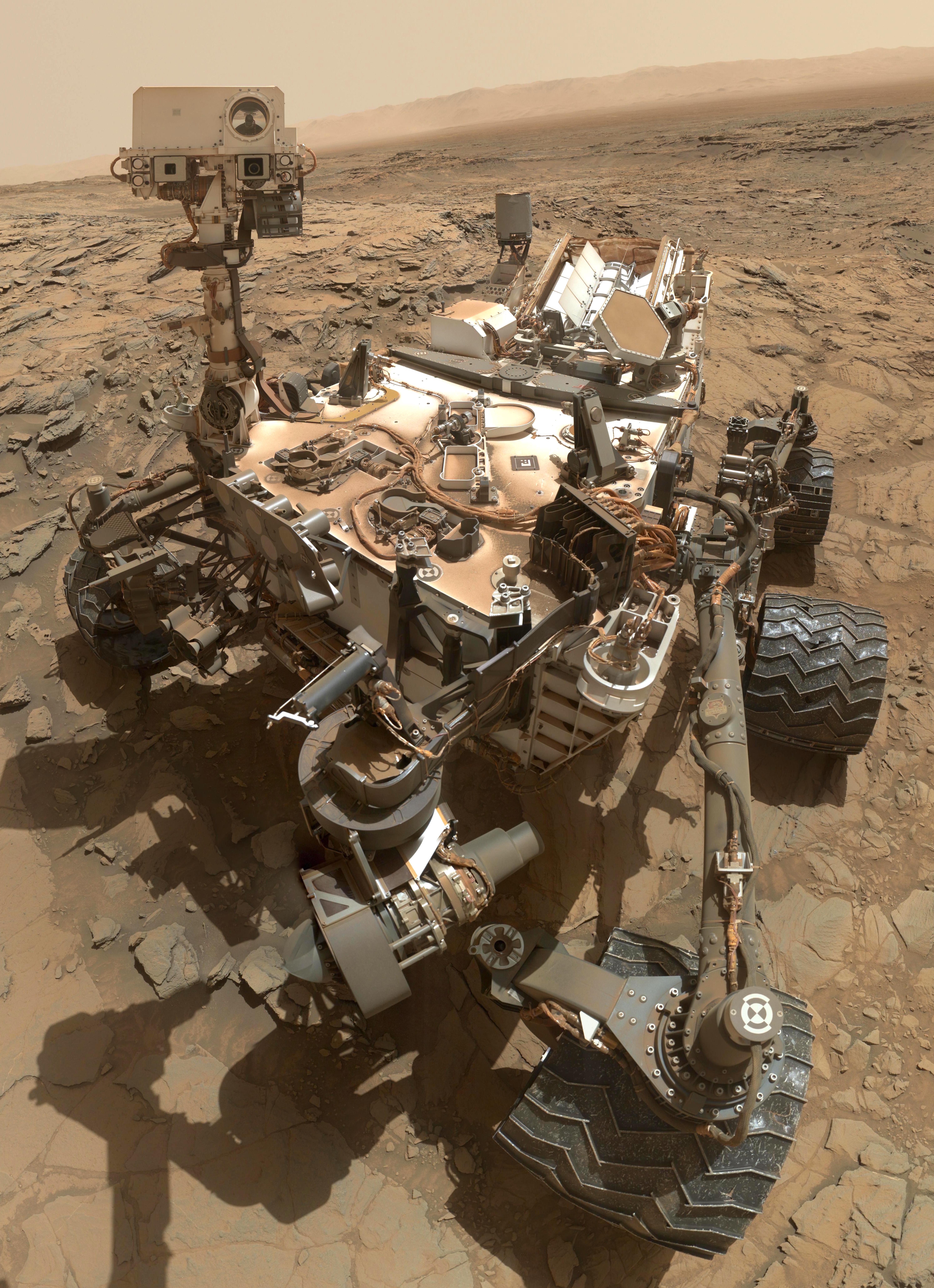
This self-portrait of NASA's Curiosity Mars rover shows the vehicle at the "Big Sky" site, where its drill collected the mission's fifth taste of Mount Sharp. The scene combines dozens of images taken during the 1,126th Martian day, or sol, of Curiosity's work during Mars (Oct. 6, 2015, PDT), by the Mars Hand Lens Imager (MAHLI) camera at the end of the rover's robotic arm. The rock drilled at this site is sandstone in the Stimson geological unit inside Gale Crater. The view is centered toward the west-northwest. It does not include the rover's robotic arm, though the shadow of the arm is visible on the ground. Wrist motions and turret rotations on the arm allowed MAHLI to acquire the mosaic's component images. The arm was positioned out of the shot in the images, or portions of images, that were used in this mosaic. This portrait of the rover was designed to show the Chemistry and Camera (ChemCam) instrument atop the rover appearing level. This causes the horizon to appear to tilt toward the left, but in reality, it appears fairly flat. For scale, the rover's wheels are 20 inches (50 centimeters) in diameter and about 16 inches (40 centimeters) wide. The drilled hole in the rock, appearing grey near the lower left corner of the image (image cropped, see original source), is 0.63 inch (1.6 centimeters) in diameter.
NASA
💡 This is just Chapter 1. The full content with all chapters, interactive quizzes, and progress tracking is available in the Octo AI app.