Mars is a planet in our Solar System. It is the fourth planet from the Sun.
Smaller than Earth
Has two tiny moons
Often called the Red Planet
Scientists study Mars to learn if life could ever live there.
Filters: f635, f546, f437 CU/LASP EMM/EXI ITF/Kevin M. Gill
Kevin Gill from Los Angeles, CA, United States
Why Is Mars Red?
Mars looks red in the sky. 🌟
Its ground has iron, like metal
The iron turns rusty when it reacts with air
This rusty dust covers the planet
So, Mars is red for almost the same reason a rusty bike looks red-brown.
Sojourner rover taking an Alpha Proton X-ray Spectrometer measurement of Yogi.Pathfinder mission - Mars exploration - NASA
NASA
Mars in Our Sky
You can sometimes see Mars from Earth without a telescope.
Looks like a bright, reddish star
Best seen at night, away from city lights
> Try this: On a clear night, look for a steady red point of light. That might be Mars!
Свет от деревни
Alexey Elfimov
Mars vs. Earth
How Mars and Earth compare:
Size: Mars is about half Earth’s size
Day: A day on Mars is a little over 24 hours
Year: A Mars year is almost 2 Earth years
So if you were 10 on Earth, you’d be only about 5 Mars years old!
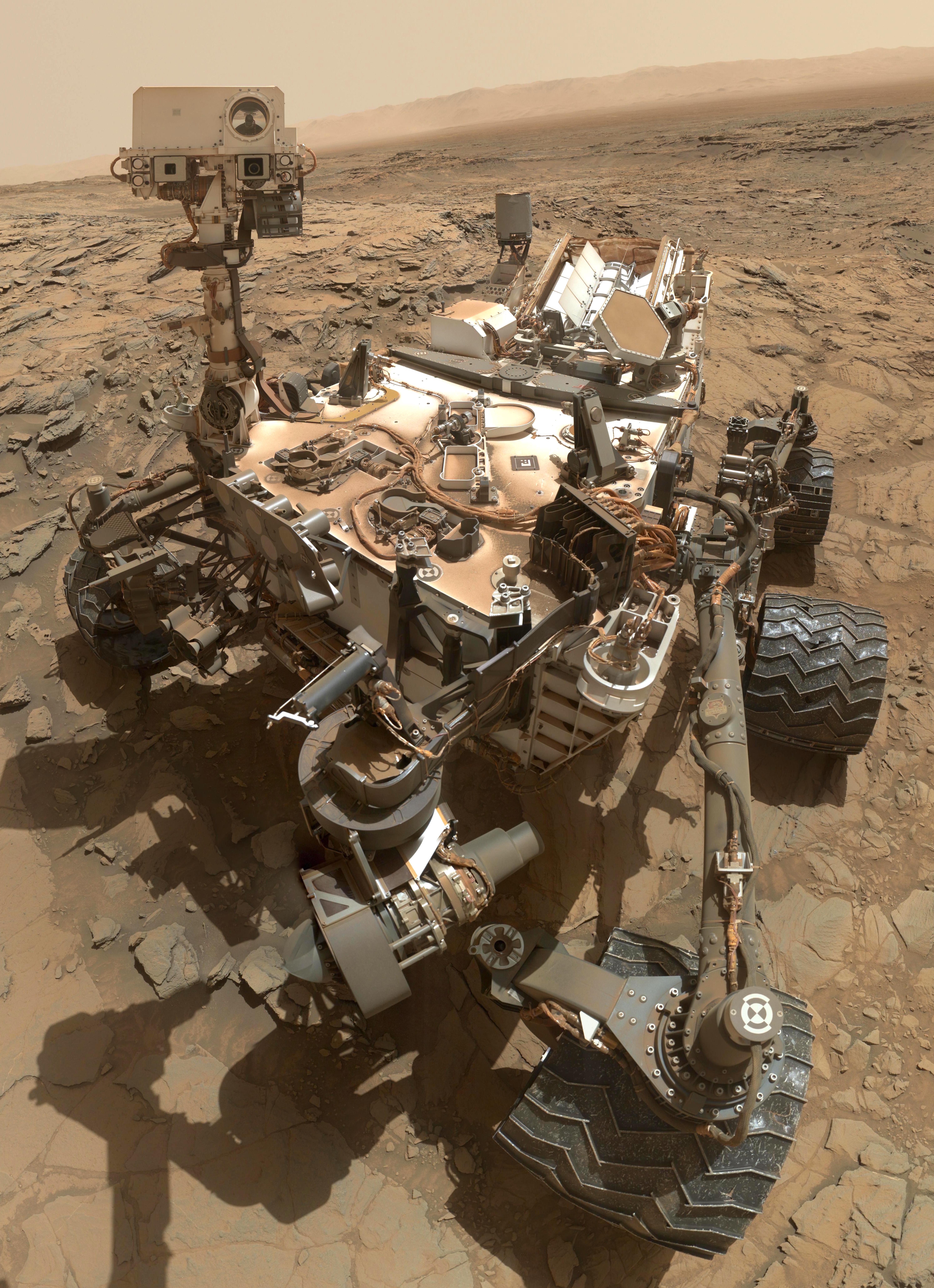
This self-portrait of NASA's Curiosity Mars rover shows the vehicle at the "Big Sky" site, where its drill collected the mission's fifth taste of Mount Sharp. The scene combines dozens of images taken during the 1,126th Martian day, or sol, of Curiosity's work during Mars (Oct. 6, 2015, PDT), by the Mars Hand Lens Imager (MAHLI) camera at the end of the rover's robotic arm. The rock drilled at this site is sandstone in the Stimson geological unit inside Gale Crater. The view is centered toward the west-northwest. It does not include the rover's robotic arm, though the shadow of the arm is visible on the ground. Wrist motions and turret rotations on the arm allowed MAHLI to acquire the mosaic's component images. The arm was positioned out of the shot in the images, or portions of images, that were used in this mosaic. This portrait of the rover was designed to show the Chemistry and Camera (ChemCam) instrument atop the rover appearing level. This causes the horizon to appear to tilt toward the left, but in reality, it appears fairly flat. For scale, the rover's wheels are 20 inches (50 centimeters) in diameter and about 16 inches (40 centimeters) wide. The drilled hole in the rock, appearing grey near the lower left corner of the image (image cropped, see original source), is 0.63 inch (1.6 centimeters) in diameter.
NASA
💡 This is just Chapter 1. The full content with all chapters, interactive quizzes, and progress tracking is available in the Octo AI app.