Mars is the fourth planet from the Sun and the second-smallest after Mercury.
Mean radius: ~3,390 km (about half Earth’s)
Orbital period: 687 Earth days
Day length: 24.6 hours
Its thin, CO₂‑dominated atmosphere and cold temperatures make surface liquid water unstable today, yet abundant geological evidence suggests a wetter past.
Filters: f635, f546, f437 CU/LASP EMM/EXI ITF/Kevin M. Gill
Kevin Gill from Los Angeles, CA, United States
Orbital and Physical Properties
Semi-major axis: 1.52 AU
Eccentricity: 0.093 → noticeably elliptical
Axial tilt: 25.2° (similar to Earth)
Consequences:
1. Pronounced seasons, but lasting almost twice as long as Earth’s.
2. Significant difference between perihelion and aphelion temperatures.
3. Polar regions experience extreme seasonal CO₂ frost growth and retreat.
Mars’ average distance from the Sun is roughly 230 million km (1.5 AU) and its orbital period is 687 (Earth) days as depicted in the red trail when the Earth's blue trail orbit as reference
Lookang many thanks to author of original simulation = Todd K. Timberlake author of Easy Java Simulation = Francisco Esquembre
Comparison with Earth
Similarities:
Day length, axial tilt, rocky composition
Differences:
Mass: ~0.11 Earth masses
Surface gravity: ~0.38 g
Atmospheric pressure: ~0.6% of Earth’s
> Lower gravity and thin air complicate human health, aerobraking, and aircraft design, but also reduce launch energy from Mars compared with Earth.
Interplanetary Spaceship, arriving Mars.
SpaceX
Moons of Mars
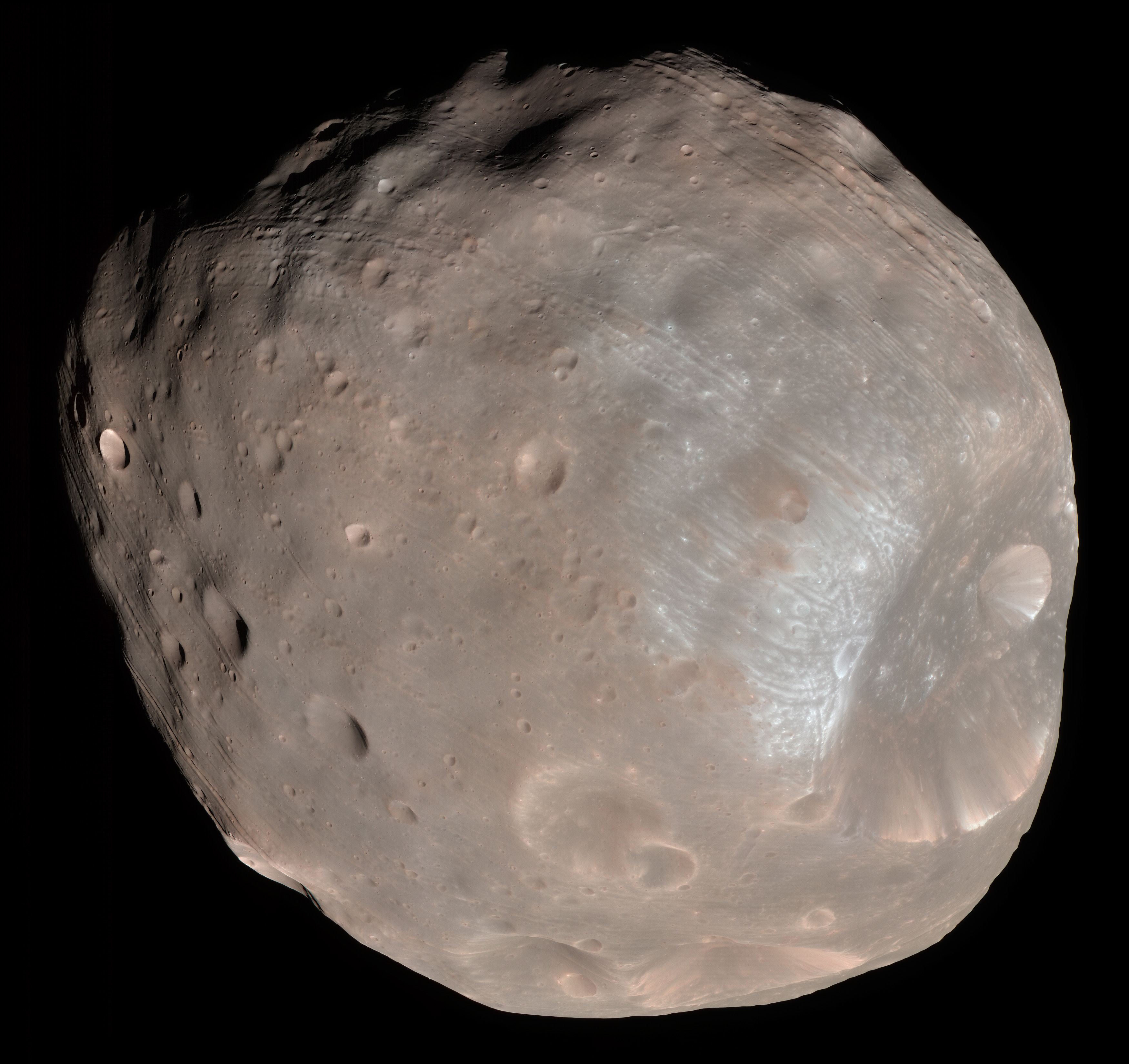
Mars has two small, irregular moons: Phobos and Deimos.
Likely captured asteroids or debris‑disk remnants
Orbits close to Mars; Phobos is spiraling inward
Phobos’ gradual orbital decay means it will eventually either crash into Mars or break into a ring. These moons are interesting as potential staging posts for teleoperated exploration of the Martian surface.
Color image of Phobos, imaged by the Mars Reconnaissance Orbiter on 23 March 2008. The High Resolution Imaging Science Experiment (HiRISE) camera on NASA's Mars Reconnaissance Orbiter took two images of the larger of Mars' two moons, Phobos, within 10 minutes of each other on 23 March 2008. This is the first, taken from a distance of about 6,800 kilometers (about 4,200 miles). It is presented in color by combining data from the camera's blue-green, red, and near-infrared channels. The illuminated part of Phobos seen in the images is about 21 kilometers (13 miles) across. The most prominent feature in the images is the large crater Stickney in the lower right. With a diameter of 9 kilometers (5.6 miles), it is the largest feature on Phobos. The color data accentuate details not apparent in black-and-white images. For example, materials near the rim of Stickney appear bluer than the rest of Phobos. Based on analogy with materials on our own moon, this could mean this surface is fresher, and therefore younger, than other parts of Phobos. A series of troughs and crater chains is obvious on other parts of the moon. Although many appear radial to Stickney in this image, recent studies from the European Space Agency's Mars Express orbiter indicate that they are not related to Stickney. Instead, they may have formed when material ejected from impacts on Mars later collided with Phobos. The lineated textures on the walls of Stickney and other large craters are landslides formed from materials falling into the crater interiors in the weak Phobos gravity (less than one one-thousandth of the gravity on Earth). In the full-resolution version of this image, a pixel encompasses 6.8 meters (22 feet), providing a resolution (smallest visible feature) of about 20 meters (about 65 feet). The image is in the HiRISE catalog as PSP_007769_9010. NASA's Jet Propulsion Laboratory, a division of the California Institute of Technology in Pasadena, manages the Mars Reconnaissance Orbiter for NASA's Science Mission Directorate, Washington. Lockheed Martin Space Systems, Denver, is the prime contractor for the project and built the spacecraft. The High Resolution Imaging Science Experiment is operated by the University of Arizona, Tucson, and the instrument was built by Ball Aerospace & Technologies Corp., Boulder, Colo.
NASA / JPL-Caltech / University of Arizona
💡 This is just Chapter 1. The full content with all chapters, interactive quizzes, and progress tracking is available in the Octo AI app.