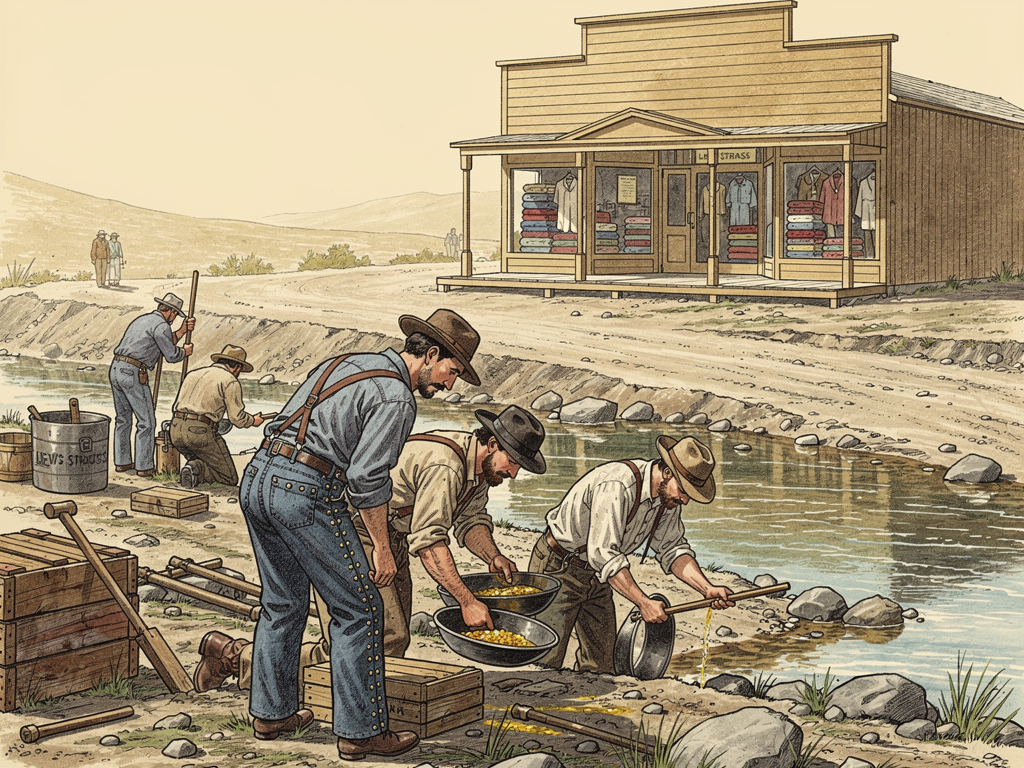
Levi Strauss, a Bavarian immigrant, arrives in San Francisco in 1853 during the Gold Rush. He sells dry goods, then partners with tailor Jacob Davis in 1873 to patent riveted work pants. These become Levi’s waist overalls, precursors of jeans. The brand emerges at the intersection of resource extraction, frontier labor, and rapid industrialization, illustrating how clothing can crystallize economic and cultural transformations.
Denim, Indigo, and Durability
Levi’s relies on denim, a sturdy twill cotton, and indigo dye, which fades on thread surfaces but clings to core fibers. This produces high abrasion resistance yet visible wear. The fabric’s economics matter: cotton’s plantation-based supply chain ties Levi’s early success to global labor and colonial systems, underscoring how a seemingly simple garment rests on complex material and geopolitical infrastructures.
The 501 as an Industrial Artifact
Introduced in the late 19th century, the 501 becomes Levi’s iconic model. Features—button fly, rivets, arcuate stitching, leather patch—encode functionality, branding, and patent circumvention. The garment exemplifies Fordist logic: standardized production, reproducible sizing, and scalable marketing. Studying the 501 is like reading a primary source on American industrial capitalism and emerging mass consumer culture.
Workwear and Class Identity
Originally sold to miners, railroad workers, and farmers, Levi’s jeans materialize class identity. Sturdy construction and utilitarian design mark them as proletarian uniform. Yet, even early on, catalog imagery romanticizes rugged labor, transforming hardship into aspirational mythology. This duality—real work vs. symbolic frontier freedom—anticipates Levi’s later ability to migrate from working-class necessity to middle-class lifestyle commodity.
💡 This is just Chapter 1. The full content with all chapters, interactive quizzes, and progress tracking is available in the Octo AI app.